
Emil Sorin BUCUR
Equipping Leaders with Strategic Judgment at the Convergence of Governance, Technological Risk, and Geostrategy — Mastering High-Consequence Decisions in a Complex Environment.
Helping boards and senior executives interpret complex environments where emerging technologies, cyber exposure and geopolitical dynamics intersect with institutional governance.
Today’s Challenge
Modern organizations operate at a critical juncture, driving technological advancement while upholding stakeholder trust, regulatory compliance, and operational security.
For board members and senior executives overseeing emerging technology adoption, cybersecurity, and AI governance, managing continuous geopolitical shifts is no longer theoretical; it is a present, high‑stakes constraint on strategy and risk.
They need structured judgment — provided by someone who has operated at the intersection of these forces under real institutional pressure.
My Mission
Guiding organizations to move decisively through complex changes. I work at the point where AI adoption, Cyber exposure, accountability, stakeholder trust, and geopolitical context must be read together—not separately.
My work focuses on helping leadership teams interpret complexity, where emerging technologies, cyber exposure and geopolitical dynamics reshape institutional decision-making.
What do I bring to the table?
The judgment that holds when the problem is too complex to route to a single function.
25+ years across military, diplomacy, and governance.
Few professionals advising on emerging technology governance have operated simultaneously at the intersection of military command, sovereign legal architecture, and multilateral diplomacy — under real institutional pressure, not from advisory distance. That operational grounding is the lens through which every governance, risk, and strategic challenge in this practice is interpreted.
Capabilities:
Technology & Governance Risk Interpretation – Identifying how AI adoption, cyber exposure, regulatory shifts, and geopolitical dynamics interact to create institutional risk — before they arrive as decisions that cannot wait for interpretation.
Governance Architecture & Accountability Design – Structuring how institutions allocate oversight, responsibility, and risk across governance layers — so that accountability is embedded in how the organization operates, not delegated to individuals or left to audits.
Geopolitical & Regulatory Intelligence Integration – Converting geopolitical dynamics, cross-jurisdictional regulatory complexity, and security environment shifts into pre-positioned institutional intelligence — before they become operational constraints.
Decision Translation – Turning the intersection of technical complexity, legal exposure, and geopolitical uncertainty into leadership-ready choices — structured so that decisions can be made, defended, and institutionally sustained.
This work begins when:
AI adoption creates governance ambiguity at board or C-suite level
Cyber risk exposure has outpaced the legal and operational frameworks designed to contain it
Strategic decisions carry geopolitical or regulatory uncertainty that existing processes cannot structure
Organizational transformation stalls because the complexity exceeds functional coordination capacity
Leadership faces high-accountability decisions under time pressure and incomplete information
Institutional trust — with regulators, investors, or the board itself — is under strain
How this engagement works:
Board and executive advisory — entering the decision process at the point where governance, technology risk, and strategic uncertainty converge, and providing the cross-domain judgment that no internal function, positioned within a single domain, can fully form.
Complexity architecture — mapping institutional exposure across AI, cyber, legal, and geopolitical dimensions into a coherent risk picture — and designing the governance architecture before that exposure materializes as a crisis.
Framework development and stress-testing — building or evaluating governance, AI governance, or cyber risk frameworks against the conditions under which they will actually be tested: regulatory scrutiny, stakeholder challenge, and high-velocity institutional change.

CORE COMPETENCIES
Strategic Domains
Where governance, technology, and global risk meet.
Institutional Governance & Legal Strategy
Understanding how institutions govern decision‑making in complex technological and security environments, and designing governance that aligns technology adoption with accountability and regulatory expectations.
assured_workload
Cybersecurity & Technology Risk
Interpreting how cyber exposure and digital infrastructure vulnerability and evolving technological risks influence governance decisions, institutional resilience and broader security architectures.
network_intel_node
AI & Emerging Technology Governance
Examining how emerging technologies reshape governance framework, strategic competition and the long-term architecture of international security, and how governance systems adapt to technological transformation.
security
Horizontal Capabilities
Enabling Systemic Perspective
psychology
graph_5
emoji_objects
handshake
Strategic Navigation
Interpreting complex environments where technological change, governance structures and geopolitical dynamics intersect.
Strategic Risk Interpretation
Understanding how governance structures, legal framework, cybersecurity, artificial intelligence and geopolitical risks interact to influence institutional stability and strategic decision-making.
Institutional Decision Architecture
Examining how institutions structure governance mechanisms capable of translating complex strategic challenges into coherent decision processes.
Technology–Geopolitics Interface
Technological transformation is reshaping geopolitical dynamics and international geostrategy, and understanding this interface allows organizations to anticipate how emerging technologies shape strategic competition and regulatory expectations.
The Experience Behind the Judgment
A Chronicle of Competency and Growth
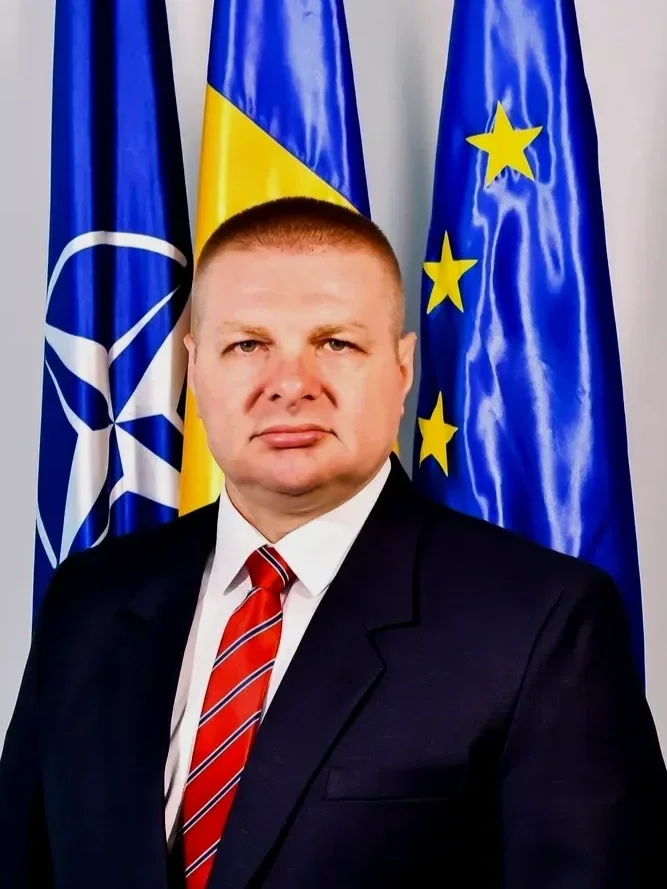
Emil Sorin Bucur operates at the intersection of governance, emerging technologies and geopolitical dynamics, helping leadership teams navigate complex risk environments and their implications for institutional decision-making and strategic stability.
As a UN Strategic Military Adviser and former Chief Legal Officer for Romania's Cyber Defense Command, he has made antifragility —growing stronger through challenge— the core of his leadership philosophy. Emil helps leaders turn uncertainty into leverage.
Most executives advising on AI, cyber, legal risk, or geopolitics come from one primary lane. Emil’s profile is different. Emil's unique blend of operational excellence, regulatory mastery, and global perspective positions him as a trusted guide for technology and defense organizations navigating today's rapidly evolving landscape.
Such cross-domain understanding supports institutions in navigating complex risk environments while maintaining credibility, legitimacy and strategic trust among diverse stakeholders.
-
Trained at Romania's Air Force Academy, Emil brings 25+ years of military leadership, including international deployments. This experience forged his operational rigor and cross-cultural agility.
-
Emil’s expertise spans military strategy, dual legal degrees, research papers, and elite certifications in Global Leadership, Business AI deployment, and corporate governance from Yale, MIT, and Cornell. This arsenal enabled Emil to lead digital strategy, to ethical deploy technologies, strengthen security, and drive measurable value.
-
During the COVID-19 crisis, Emil guided digital transformation governance framework for the Ministry of Defense, developed specialized competency programs, and coordinated inter-institutional modernization of national cybersecurity legislation fostering adaptive cultures that emerged stronger from disruption.
-
As UN Strategic Military Adviser, Emil combines military and diplomatic skills advises on military and geopolitical risks, advancing Romania’s interests and strengthen global peacekeeping. He bridges institutional systems and global stakeholders, applying diplomacy and geopolitical foresight to master business challenges and lead with purpose on the global stage.
Connect for Strategic Collaboration
Conversations about governance, emerging technologies, and strategic risk often begin with a simple exchange of perspectives.
Engagements are taken selectively — shaped by strategic fit and by the institutional responsibilities that define a career spanning both public service and independent counsel. Where those responsibilities affect the scope or form of collaboration, it is addressed directly at the first conversation.
If the challenge your organization is navigating aligns with the areas this practice addresses, the next step is a focused conversation.